On Rock & Roll Lore
for the love of a good story behind the song

When I became a guitar and bass teacher of “digital natives” – i.e., kids born post-internet – I realized how much my love of music is connected not just to songs, but also to music lore. Most folks know me as a musician, but I claim only two other muso ancestors: my late father, Robert Burke Warren, Sr, who taught himself guitar, and was a pretty good campfire troubadour; and opera star Josephine Lucchese, the “American Nightingale,” my maternal grandfather’s Texan/Sicilian cousin (my first cousin twice removed). The list of storytellers in my tree, often professional writers, is far longer.
My unusual retention of music lore became evident when, during lessons, I found myself compulsively launching into the stories behind songs, artists, bands, and era-defining music moments. Resonant, detail-rich tales that fascinate me but generally bore my students. I try not to take it personally when their eyes glaze as I go on about, say, how the Beatles were actually the true working class street toughs, and the Stones were from cushy homes.
And/or
…how famed illustrator George Underwood, the guy who disfigured Bowie’s eye in a teenage punch-out over a girl (Bowie had put the moves on George’s bird), not only remained Bowie’s friend but designed the iconic covers for Hunky Dory and The Rise and Fall of Ziggy Stardust & the Spiders From Mars.
…how the “Disco Sucks” craze was a terrified, racist/homophobic backlash over the commercial triumph of dance music that rose from queer and non-white communities.
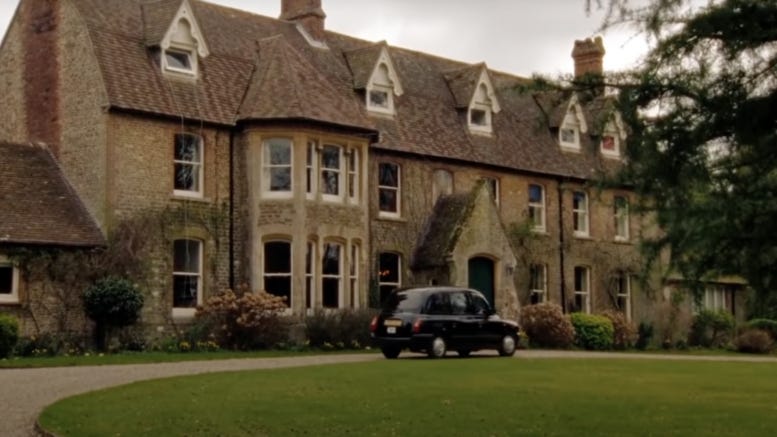
…how Elvis Costello recorded most of his seminal debut My Aim is True as Declan MacManus, longhaired data entry clerk for Elizabeth Arden, and how his then-backing musicians were in Clover, a country-rock band featuring Huey Lewis and future members of the Doobie Brothers, and how Clover lived for a time at Headley Grange, the dank, three-story stone manor where Led Zeppelin, with the help of the Rolling Stones’ mobile recording truck, wrote and recorded their masterpiece IV, which includes both “Stairway to Heaven” and “Black Dog,” the monster riff of which was written by bassist/keyboardist John Paul Jones, who was inspired by Peter Green’s monster riff in Fleetwood Mac’s “Oh Well.” And another thing: the title “Black Dog” was inspired not by Satan, but by a black Labrador retriever roaming the property.
If you’re still reading, you are my people. Clearly, I could go on and on, into the 80s and 90s, Madonna lore, REM lore, Nirvana lore, Tupac lore, but you get the idea.
A large percentage of my students are stellar players. They love to learn, and they’re devoted. But their innate need for lore, both visual and oral, is largely fulfilled elsewhere. I introduced one particularly talented guitarist to Led Zeppelin, and they became a fan, outplaying me in no time, but when I offered to loan them both the Led Zeppelin DVD set How the West Was Won, and the excellent LZ biography by Bob Spitz, they said no thanks. They were not interested in poring over the visuals, or delving into the (often unpretty) biographical details. But they can play the shit out of “Black Dog.”
Of course music for these kids is not like it was for me and my peers, just as it was not the same for my parents, grandparents, etc. My students get most music for free, which sets them apart from every generation prior, and, I think, is part of what makes them less hungry for more – for the visuals, the stories. It’s paradoxical – what they get for free they are only mildly interested in.
I am loath to be that guy and say it was “better” back in MY day, but I do feel fortunate it was so different, fortunate I had to put considerable effort, and coin, into finding my musical heroes. If I was a youngster now, I wonder where my jones for story would be satisfied. And if I’d been born in a different century? The mind reels.
Like almost everyone, my students are deluged with more text than any humans in history, via, well, texting, but also the internet in general. Plus, they, and I’m sure, you, dear reader, are inundated with images chosen for them, and, as the song goes, every picture tells a story. It’s no surprise my students’ colonized minds have little extra space for the lore of their teacher’s heroes. When I inquire about their music – which, interestingly, ranges all over space and time – I get very little information, visual or otherwise. They’re either holding out on me, or they have no info to give, no tea to spill.
In some ways, we’ve been here before. Aside from the free aspect, my students receive music in much the same way people did in the mid-20th century, i.e. with little or no compelling, contrived visual aspect. Not a lot of story, no liner notes. Just a song blaring from a shitty speaker. Upon hearing Elvis on the radio in 1956, many assumed he was Black. The visual storytelling apparatus was just getting started, with TVs in only half of American homes.
When I edited Cash on Cash: Interviews & Encounters with Johnny Cash, I discovered few substantive articles had been written about Cash before the late ‘60s. He created his best work (mid 50s to late 60s) with no literati of any kind deigning to write about it. Fan magazines, yes, but nothing of any depth. With the late 60s dawning of pop culture writing – Rolling Stone and Crawdaddy leading the way – folks suddenly wanted to talk at length to Cash, Dylan, Lennon, Bowie, et al. These master storytellers, promoting albums, were ready for their close-ups, crafting personas for the fans as the tapes rolled and the photographers backed up to get all of them in the lens.
This is where I come in. In addition to being a consummate Word Guy, I am a product of this Golden Age of LPs, of music as both tactile and aural medium, massive record stores, the heyday of hard copy rock journalism. (I recently lifted a circa late ‘70s Rolling Stone from a box and was struck by its heft, the length and breadth of the articles, the number of quality photos, and, crucially, the ADVERTISING.) Also, MTV aired in ATL when I was first venturing onto club stages. ‘Twas the apotheosis of music as a visual experience, of fans enjoying new opportunities to know artists, or at least to know what those artists (and their publicists) wanted you to know about them. Sure, their tune is good, but can they dance? What do they look like all gussied up for the camera? What kind of home did they become an artist in? What are their thoughts on space travel, politics, family, architecture? How do they manage their insane lifestyle that looks both fun and scary?
I understand those who find all of the above tedious and distracting, but I don’t share their disdain. And I understand my students’ lack of interest. But I could not stop spinning music lore even if I wanted to. I’m so compulsive, I’ve spent the last few years writing a novel (almost done) that contains several threads of music lore. It is the greatest marshaling of my creative energy to date. Bands/musicians whose lore I’ve used as raw material: Led Zeppelin, Nirvana, Mötley Crüe, Hole, Brian Wilson, Soundgarden, every rock star who died choking on vomit (Hendrix, Bon Scott, John Bonham), and a few rock star spawn, who fascinate me to no end. Dear reader, it’s right up your alley. There’s also a wolfdog in it.
Although lore is not so important to my little Generation Alpha cohort, I don’t worry about it vanishing any time soon. One of my students had his mind blown by A Complete Unknown and is now a Dylan fanatic. Several others were slayed by Bohemian Rhapsody. As I write this, Michael is breaking records at the box office, and The Beatles - A Four Film Cinematic Event is in pre-production, slated for release in 2028. Memoirs by Dave Grohl, Springsteen, Bono, Cameron Crowe, Dylan, and Patti Smith were bestsellers.
All these artists, however, are from the Golden Age of music-as-story, of liner notes, videos, in-depth profiles in magazines that will later molder in a basement. When my students are middle-aged and older, will their favorite musicians be the subjects of movies, documentaries, memoirs, biographies? Will a mid-twenty-first century youngster be bored with detail-rich tales of Charli xcx, Bad Bunny, Doja Cat, Teddy Swims, et al? (All of whom are great. I mean no disrespect.)
We are a storytelling species, so I’m sure my charges, grown and flown, will bore and annoy these as-yet unborn children with something. Something wild and strange that bears repeating via unadorned human voice, in a future we cannot comprehend.
MORE LORE:

The Unsung Midwives of Rock II: About a Girl

I need an easy friend / I do... with an ear to lend / I do... think you fit this shoe /I do... won’t you have a clue / I’ll take advantage while / You hang me out to dry /But I can’t see you every night for free / I do.
My chat with 90s Rock Icon Melissa Auf der Maur

One of the many advantages of not dying young is the increasing likelihood you’ll cross paths in real time with a fascinating person you once knew only via pixels and sound waves. As I wrote when I interviewed Heart’s Nancy Wilson, aging – gracefully or not – is a kind of equalizer, offering ever more to talk about, especially subjects like grief and gr…
Elvis Presley's "Get Back"

For me, the highlight of Baz Luhrmann’s Elvis is the recreation of what we now call the ’68 Comeback Special. Just as Peter Jackson’s 2021 documentary Get Back reveals the Beatles fitfully recapturing past glories, the actual ’68 Comeback Special offers an intimate view of an insecure icon re-awakening to grandeur as the cameras roll. In both cases, the…
A great piece, and one that helped me mentally organise some things I’ve only previously noticed in a vague way. Thank you!
I’m the same as you - the lore is a huge part of the obsession. It’s not incidental either, but gives so much extra weight to the listening experience. But I notice the same glazed expression even in people who really love music!
I think I can see this lore divide in my brief time on Substack, too. The 20-odd essays I’ve written so far, deep dives into 25-odd tracks, have had three general modes of expression: 1) the personal - the song as exploration of my own life; 2) the social/political - the song as exploration of a sociopolitical moment or theme; 3) music lore - the song as exploration of a (usually neglected) artist’s career and theme details of it.
The third is by far my own favourite stream of my writing, but I think it’s the one that grabs the general reader least. Much food for thought.
We geeks know that the lore is the glinting, golden thread that illuminates the work. You'll be glad to know I've got a couple of Zeds over here who inherited my thirst for lore, albeit one about different ways and means than the other. Here's to the preservation of the liner notes!