Live to Tell, Tell to Live
I was a teenage enabler

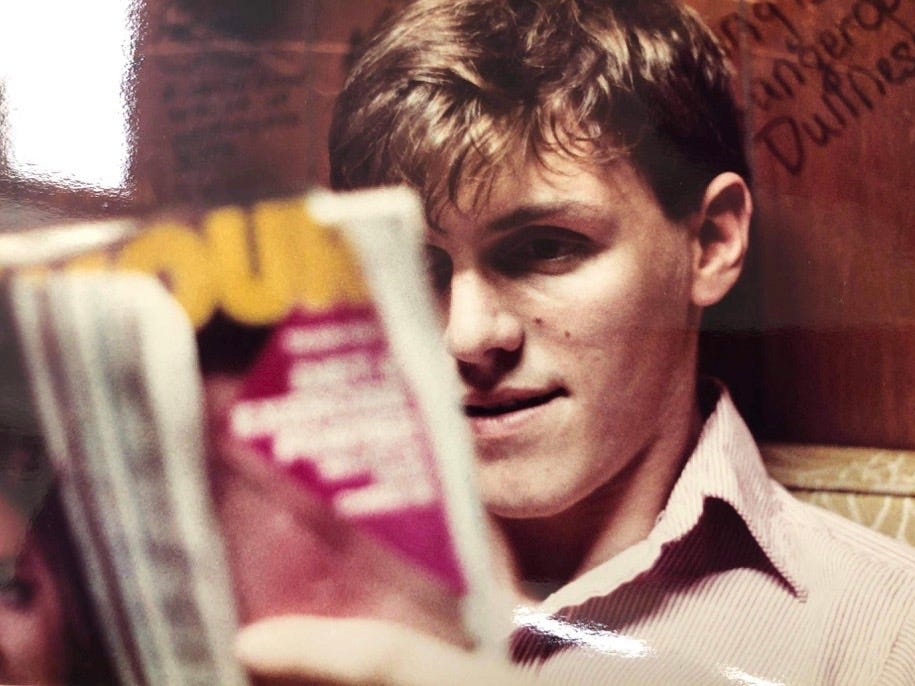
2025 was quite a year for calling out abusers. Other news items are currently stealing focus (not an accident), but I retain hope 2026 will outshine last year in terms of exposés and schadenfreude.
When predators are brought down, I’m both glad and regretful; so very glad victims acted, but regretful I squandered a chance to break a conspiracy of silence.
Granted, I was a boy. A fatherless, insecure, latchkey kid, a high schooler. In the decades since, I’ve learned my memory for certain things is exceptional. A mixed blessing, that. This talent can curdle into rumination, but luckily, I’ve got a creative spark. When certain memories are triggered, that spark expands into flame. The trick is to wield it properly.
My experience of time is changing; old memories are crystalline, recent ones hazy, evidently a quirk of the elder mind. And while I endeavor to exist in the moment, a stubborn part of me still wonders if it’s possible to make amends for past mistakes, and in so doing, maybe help others. Perhaps, by writing a bit of it down, I can brighten some corners.
I hesitate. Just typing these words, I wrestle with a familiar brand of apprehension. Forty-odd years later. Like I’m shirking my duty as esteemed guardian of a mentor who took advantage. It amazes me what remains within from that impressionable time. Jingles, sitcom dialog, SNL bits, the scent of Dior Poison, and a blind, sad desire to be considered cool by a powerful person with no integrity, a teacher who should not have been around young people.
This teacher/mentor not only repeatedly bed at least two of his female high school students – my friends – he cannily groomed me and other teens for an inner circle. We would know his secrets. Not coincidentally, others in this group fit a profile like mine: fatherless, unsupervised, trusting. Most of us bound for lives torn by addiction. Although clueless, we considered ourselves smarter than the average bear, and teacher encouraged this sense of superiority. He frequently ridiculed his teacher peers in private. He ridiculed us, too, played us off each other. All in “fun.”
In hindsight, I see how easily we could have exposed him, not only for the transgressions with the girls, but for casual, deeply unethical boundary-defying in class. I don’t recall anyone openly considering it. Exposing him would have destroyed our sense of exceptionalism, which we desperately needed, or felt we needed.
Teacher, a canny addict, had us figured out. He was a thief of innocence, and like most thieves, part of him wanted to get caught. But most of him didn’t. Like a savvy poker player reading tells, he assessed our weaknesses, and bet accordingly.
I recall battered gym mats on the grubby tile floor of a windowless cinder block classroom. Hum of fluorescents overhead, cacophony of kids, potpourri of perfumed sweat and teenage funk, the whiff of teacher’s Camel unfiltereds baked into his frayed hoodie.
In the glow of our undivided attention, teacher says, “You guys gotta learn how to properly limber each other up for performances. It’s as much about the body – your instrument – as it is about your mind.”
We nod, rapt.
He instructs beautiful, tall Vicky, a senior, to lie on her belly on a mat in front of the class. She does. His hand hovers over the seat of her sweatpants.
“Now, guys, this is Vicky’s butt,” he says, almost angrily. We titter. Vicky rolls her eyes. “Let’s be mature about this, OK? It’s just a muscle, an important muscle, actually the biggest muscle in the human body. That’s it.”
He kneads Vicky’s butt, then moves to the small of her back and up to her shoulders. She lies limp, her eyes vacant.
We pair up and massage each other as per his guidance, while he observes. No one ever brings it up again.
Teacher’s first star pupil and student lover is seventeen-year-old Roxanne, a senior. He frequently casts her as the female lead in productions and classroom scene work. Ostensibly to demonstrate how to perform Shakespeare, he and Roxanne present a scene from Taming of the Shrew. Teacher casts himself as the wily suitor Petruchio, and Roxanne as Kate, the cantankerous, rich, beautiful “shrew.”
Teacher and student prowl the classroom in their Capezios, frequently tussling. The scene teacher chooses – Act 2, Scene 1 – is an argument rife with sexual tension, including a line where Petruchio makes a pun about putting his tongue in Kate’s tail.
We watch, riveted at the display, about which none of us speak to anyone. After she graduates, Roxanne will confirm to a fellow member of the inner circle what we all knew, but none dared speak of. Like everyone else, however, she will not use the power he grants her to ruin his life.
Around this time, I have become a bass wunderkind. Teacher invites me to bring my bass and amp to his bachelor pad so we can “work on stuff.” I know he and my seventeen-year-old friend Melody are often coupling secretly in this very space, though she and I will not talk about it for years. Like Roxanne before her, she is frequently cast as the lead in plays.
In his cramped apartment, while he sucks down a Bud, I improvise on my Fender, showing off the technique I’ve honed in the basement of my home. I also share some songs I’ve written for my band. That aforementioned creative spark is fitfully emerging.
Teacher enthuses about my musicianship and songwriting. He grins slyly and tells me he’d lied on his job application to teach at my high school. He laughs contemptuously at the administrators’ gullibility, and swears me to secrecy. I feel like a favored pal to my mentor, connected to the only authoritative male in my day-to-day life. That feeling of paternal intimacy is drug-like.
I write this from what I hope is middle age. Sixty has so far been extremely noteworthy. In the past year, five men I know either my age or close to it have experienced major cardiac issues. Two survived, three died.
Last year, a dear friend, the same age as me, died painfully from ALS. She wouldn’t allow me to visit her deathbed. Another succumbed to crippling MS, another died suddenly in her garden, felled by a stroke. I sang at all their memorials.
Every few weeks someone receives a cancer diagnosis, or must go to urgent care, or the ICU, or the psych ward, because their body or mind is doing something unexpected and dangerous.
More and more friends are cyborgs, with titanium knees or hips, or hearing aids, and/or they’ve been implanted with stents and bypasses, and/or they ingest daily, side effect-laden pharmaceuticals to stay alive and, perhaps, sane. Pills to sleep, perchance to dream. Pills to ward off chronic, life-altering pain.
I understand none of this will abate going forward. On the contrary. With each healthy day I’m granted, that understanding becomes less intellectual and more visceral. In the same way I shout down the line to high schooler me, the ghost of my future self is ever louder in my ears. I’m trying to listen.
I recently got my first (but certainly not last) full cardiac checkup, and, praise be, my numbers are mostly very good, all things considered. I may one day be a cyborg, but not just yet. On days when my mind is clear, I can’t adequately express my gratitude for this renewed lease. Nevertheless, I’ve made some changes, physical and otherwise. Hitting publish on this post will be one of those changes.
In the early 20-teens, my Gen Z son was entering high school. We discussed the dangers of alcohol and drugs. I shared the blight of addiction in our family tree. With the same intent, I related the cult leader-like hold this teacher had on me and my friends. (The above vignettes are a mere sampling.) My kid and I mused on the person I was, my needs, fears, predispositions. Parenting had clarified a lot for me. Still does.
Fast forward to 2025. As abuser take-downs mount in the media, my now-twenty-seven-year-old kid is visiting. Over tea in the house in which I co-raised them, we once again discuss the “conspiracy of silence” dynamic. I’m reeling because two of the 2025 abusers-in-the-news are favorite authors of mine. One had crossed paths with my son. The third abuser was a teacher, someone I knew a little bit, and loathed a lot. He’d tried unsuccessfully to bring my charismatic kid into his dysfunctional scene.
Unlike me in my teens, my son hadn’t been compelled to pledge fealty to a mentor. My kid tells me they reckon their needs were not, and are not, like mine were back in ye olde 80s. They brook a lot less bullshit than their pops.
I consider past visits to my son’s teachers. One teacher informed me I cost her a night of sleep by coming at her enraged, forcing her to do right by my kid. She said I did the right thing, which I already knew. My kid told me it changed their life, in a good way.
To be clear, I’m a flawed parent/human. I made, and still make, lots of mistakes, over which I fret. Errors of action and, worse, inaction. Nevertheless, I am reassured some positively pivotal choices have not gone unnoticed. My hyper-vigilance can be tiresome, but it has an upside.
I time-travel to my younger self. I tell him about a conversation he’ll have when he’s a sixty-year-old father, a lucky man. I tell him a kitchen table chat with his grown child will ease the regret of teenage passivity. I tell young RBW that his remorse over enabling a predator will be put to good use. To circa 1982 RBW I say, “Millions of moments are not yet spent, redemptive choices not yet made. The story isn’t over.”
I tell my younger self, “Time is a thief, yes, but occasionally a generous one.”
Thank you for another honest, compelling account, Robert.
Love the title!